.jpg/:/rs=w:800)
Why James is Running
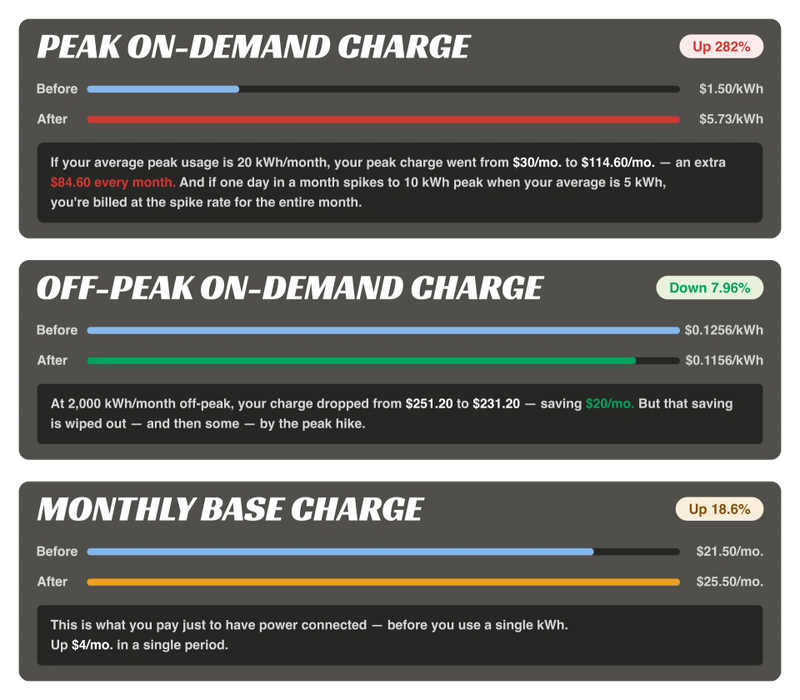
Peak On Demand Up 282%
($1.5/kwh -> $5.73/kwh) Costs $84.60/MO. More
Base Charge Up 18.6%
($0.1256/kwh -> $0.1156/kwh) Costs $20/MO. Less
Off Peak Demand Down 7.96%
($0.1256/kwh -> $0.1156/kwh) Costs $20/MO. Less
So now, you're Paying $68.60/MO. More for Your Electricity
Energy Costs Are Rising — And Your Bill Could Be Next
What's happening now — and what it could mean for your home and your wallet.
LPEA's emergency reserve fund was created to stabilize electric bills when wholesale energy costs rise.
That fund is now being depleted to prevent rate increases this year.
At the same time, there is a growing push toward all-electric homes. Before that happens, consider the impact:
· Electric heating can cost 30–60% more than natural gas
· Fully electric homes can significantly increase your monthly bill
During high demand, some utilities are requesting the ability to control thermostats remotely, adjusting temperatures in extreme weather. This means less control inside your own home.
LPEA's on-peak hours (4pm–9pm) are when most households are active — cooking, heating or cooling, and using appliances.
Here's what many people don't realize:
Your bill can be based on your highest single day of usage — not your average.
· 29 days at 5 kWh
· 1 day spikes to 10 kWh
You may be billed at 10 kWh for the entire month.
Example: $28.65 becomes $57.30 based on one peak day.
Some members have also reported being muted during public meetings when asking accountability questions.
The Issues
Your Rates: The Numbers They Don’t Advertise
Accountability: Who’s Answering Your Questions?
The Transition: What Comes Next

The Contrast
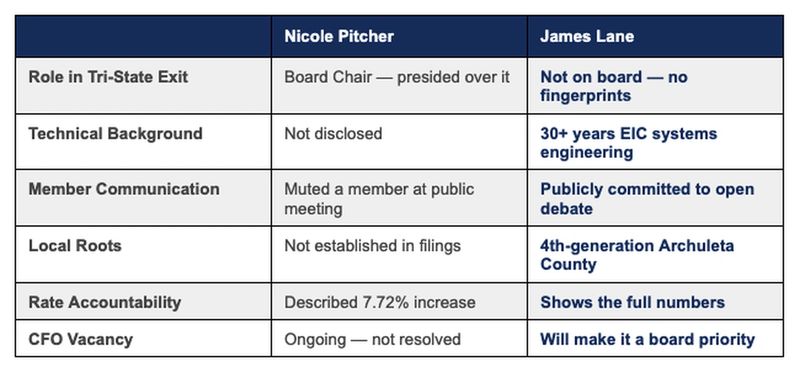
GOVERNANCE COMPARISON — DISTRICT 1
About James Lane
James Lane grew up knowing the land costs something. His family has worked in Archuleta County since the 1940s — he is a fourth-generation rancher in Allison, Colorado, where he and his wife of 32 years have raised their two children and kept the place running through drought years, market swings, and everything the high country throws at a working operation.
For the past 30 years, James has been an electrical and control systems engineer. His experience spans hydroelectric, nuclear power, solar, battery storage, oil and gas, and industrial systems. He has worked alongside Fortune 500 operations teams, served at BP, and mediated high-stakes technical disputes where the cost of being wrong was measured in millions of dollars.
He is the person you call when a system is in transition — someone who can clearly explain what is happening to a C-suite, a field crew, or a neighbor at the barber shop.
He also understands cooperative governance from the inside. He has served on the Pine River Canal Company board, managing real fiduciary responsibility involving water and money. He also served as President of the Mt. Allison Volunteer Fire Department and volunteered with the Los Pinos Fire Department.
He and his wife share the ranch with five dogs and six barn cats.
He is not a politician. He does not have a political background, a party affiliation, or an ideological agenda.
He is a neighbor who knows what he is doing — and believes your cooperative deserves that right now.
.jpg/:/rs=w:800)
How to Vote
Ballots are mailed to all LPEA members April 20.
DUE: May 19 by 4PM
Drop your completed ballot at the secure LPEA drop box:
LPEA Durango Office - 45 Stewart St., Durango, CO 81301
You can also Vote Online beginning April 20 through LPEA Smarthub at lpea.coop.
DUE: May 19 by 12PM
Annual meeting and final results: May 20, 2026
Every ballot counts in District 1 — in 2025, the average LPEA district saw just over 2,500 Votes cast.
Your Vote is not a formality.